Rest Smarter, Live Brighter

Rest Smarter,
Live Brighter.

What if the one thing standing between you and your best work, your clearest thinking, your most present self — isn't another habit, skill, or strategy?

We optimise almost everything. And yet most of us have never truly learned how to rest. Not really. Not in a way that actually restores us.

Rest Smarter Live Brighter
Never feeling fully rested.
Difficulty concentrating and making decisions.
Snapping at loved ones.
Pulling creativity by its threads.
Barely getting through the day.
Functioning, but not thriving.
It is not about lack of discipline and motivation. It is not about being comfortable where you are — it isn't. You may simply be chronically, quietly under-rested — and not even realise it.

Here is what I know after years of working with high-performing professionals: resting poorly is rarely just about sleep. It is about a nervous system that has forgotten what safe feels like. A mind that hasn't learned yet when to let go. A body that has been asked to perform — and never given permission to rest.

That is what this programme addresses. Not with hacks. With understanding. Understanding emotionally, physically, cognitively. Understanding, and adjusting.

What is your body actually doing while you sleep?

Rest is not absence. It is the most productive thing your body does in any twenty-four hour period.

During deep sleep, your brain is physically cleaned by the glymphatic system — cerebrospinal fluid flushes out the waste products that accumulate during waking hours, including the proteins associated with cognitive decline. Memories consolidate, moving from short-term storage into long-term understanding. Emotions are processed and filed — the nervous system does in sleep what it simply cannot do while you are conscious and moving through demands.

Cortisol drops to its lowest point of the day. Growth hormone is released, repairing tissue and rebuilding physical resources. The immune system activates. Creativity deepens — the brain makes connections during sleep that it cannot make while awake.

Science continues to discover new dimensions of what happens during deep sleep. What we know with certainty is that it matters far more than most of us treat it.

When the body does not get the chance to do this work — night after night, week after week — the effects accumulate quietly and deeply.

Cognitive function degrades. Decision-making becomes slower and less reliable. Emotional regulation frays — hence the short temper, the disproportionate reactions, the feeling that you have nothing left by evening. The immune system weakens. Creativity dims. The sense of meaning and motivation that normally carries you through a demanding day becomes harder to access.

This is not weakness. This is biology. And biology, when you understand it, responds. The body, given the right conditions, knows how to find its way back.

Your exhaustion is not built at night. It is built between 9am and 6pm — in the unbroken cognitive load, the emotions set aside, the stress carried home unprocessed. This programme works there first. Because that is where the solution lives.

Read more — Your exhaustion is not built at night →

A blueprint, not a checklist.

These are not steps to follow in order. They are tools — and part of the work is understanding which ones matter most for you.

Block 01

Somatic Awareness

Your body has been communicating with you all day. The tension in your shoulders by mid-afternoon. The shallow breath that arrives with back-to-back meetings. This building block develops your capacity to read and respond to these signals in real time — before they accumulate into a nervous system that cannot switch off at night.

Block 02

Energy Management

Managing time is something you already do well. Managing energy is different. This building block looks at how you spend and recover attention, emotion, and physical resources across the day — identifying where the leaks are, and creating rhythms that naturally prepare your body for rest.

Block 03

Cognitive Restructuring

The thoughts that loop at 2am are not random. They are patterns — learned, habitual, and changeable. This building block works directly with them: learning to observe, examine, and gently replace the thinking that keeps your nervous system in a state of alert long after the day is over.

Block 04

Behavioural Activation

Small, consistent actions that rebuild your body's trust in its own capacity to rest. A transition ritual between work and home. A worry download before dinner. A closing routine that tells your nervous system the day is genuinely done. Not through discipline — through repetition and gentleness.

"Rest is not a luxury.
It is the most essential maintenance
your body knows how to perform."

— Isabel V Echavarria

Is this for you?

This programme is for you if...

  • You lie awake at night, or wake at 3am with a running mind
  • You sleep eight hours and still feel depleted
  • You function well on the outside, but feel exhausted on the inside
  • You carry a background exhaustion that never quite lifts
  • You are ready to address your exhaustion at the root — not with another supplement or sleep tip

This is not...

  • A sleep hygiene checklist
  • A collection of hacks and supplements
  • A fix applied at night for a problem that builds during the day

It is a blueprint — one you build for yourself, that fits your life and your nervous system.

"Rest Smarter, Live Brighter treats rest not as a problem to fix, but as a capacity to restore. And it does so by addressing the patterns that are built during the day — because that is where sleeplessness, burnout, and chronic exhaustion are created."

— Isabel

Watch: Is this you?

Looking for confidence, freedom,
creativity and energy?

Video coming soon

Four people. Four patterns. One thread.

Cognitive Restructuring

Martin

When the mind won't stop at bedtime

Martin is a designer and entrepreneur. Creative, driven, running his own studio. Every night, the moment he got into bed, his mind would start rehearsing — conversations that hadn't gone well, decisions he was second-guessing. It could take him over an hour to fall asleep. He came to me not because he thought it was a sleep problem. He came because his creativity was suffering.

The first thing Martin needed to understand was that trying to force his mind to stop thinking was making things worse. Suppressing thoughts increases their frequency — the brain responds to effort with more effort.

We introduced a short worry download before dinner, reframed "I need to sleep" — which creates performance anxiety — to "I am resting, and my body knows what to do," and added a paradoxical intention technique that quietly removed the pressure keeping him awake.

Within three weeks, his sleep onset time dropped from over an hour to under twenty minutes.

"He told me later that the creativity block and the sleep problem had turned out to be the same problem."

Cognitive Restructuring · Acceptance

Juan Carlos

Letting go of what you can't resolve

Juan Carlos built a financially stable business in his fifties. A decade earlier, a business partnership had ended badly — a betrayal, as he experienced it, that he had never fully processed. On paper, he had moved on. In practice, every night told a different story. The same thoughts arriving as soon as the day quietened. Replaying conversations. Asking why — again and again — as though this time the answer might finally come.

Our work together helped him see that understanding might never come — and that peace did not require it. Three practices made the most difference: a pause technique, a structured process for examining whether a belief was serving him, and radical acceptance — the recognition that some situations cannot be fully explained.

After three months, Juan Carlos was sleeping six uninterrupted hours for the first time in years.

"I stopped waiting for a closure that was never going to come. And somehow, that was the closure."

— Juan Carlos

Behavioural Activation · Energy Management

Vicky

When there is no boundary between work and rest

Vicky is a digital marketer based in Madrid. Energetic, ambitious, deeply committed to her clients. She had five alarms to get up each morning, worked until midnight most nights, and answered messages in bed until she fell asleep from exhaustion. During an important client presentation, she lost her train of thought completely — and sat in the silence that followed, knowing something had to change.

We built a closing ritual — fifteen minutes each evening in a rocking chair by the window. She gave thanks for the day, noted what she had accomplished, identified the three most important tasks for tomorrow, and mentally filed everything else until morning. Her body began to associate that chair, that ritual, with the permission to stop.

Six months later, Vicky keeps a consistent sleep schedule and starts most days with genuine energy. When she travels, she takes the blanket from the rocking chair with her. Her body knows what it means.

"I'm not just sleeping better. I'm living better."

— Vicky

Somatic Awareness · Sensory Cues

Alex

When monitoring becomes the obstacle

Alex is a digital nomad and entrepreneur. He moved cities every three months and optimised everything he could measure — including sleep. A wearable tracked his steps, heart rate, and sleep stages. He had a set bedtime, a locked phone case, a carefully constructed sleep environment. On paper, his sleep hygiene was immaculate. And yet he woke up exhausted every morning.

In quantum mechanics, physicists have found that the act of measuring a system at the subatomic level — introducing a physical interaction to detect it — changes the system's behaviour. The measurement interaction itself collapses it into a single, fixed outcome. It is not about being watched. It is about being measured.

I asked Alex: what if your nervous system was doing something similar? Every tracker, every metric, every alarm was a measurement interaction — and a system that is always being measured never fully settles. We introduced sensory cues instead: a specific scarf over his pillow in each new city, a drop of his chosen scent before sleep. He removed the sleep tracker. Not permanently — but long enough to break the cycle.

"The hardest part was trusting that doing less — observing less — could actually produce more. But that, it turned out, was exactly what my body had been waiting for."

— Alex

Results may vary. Individual circumstances apply.

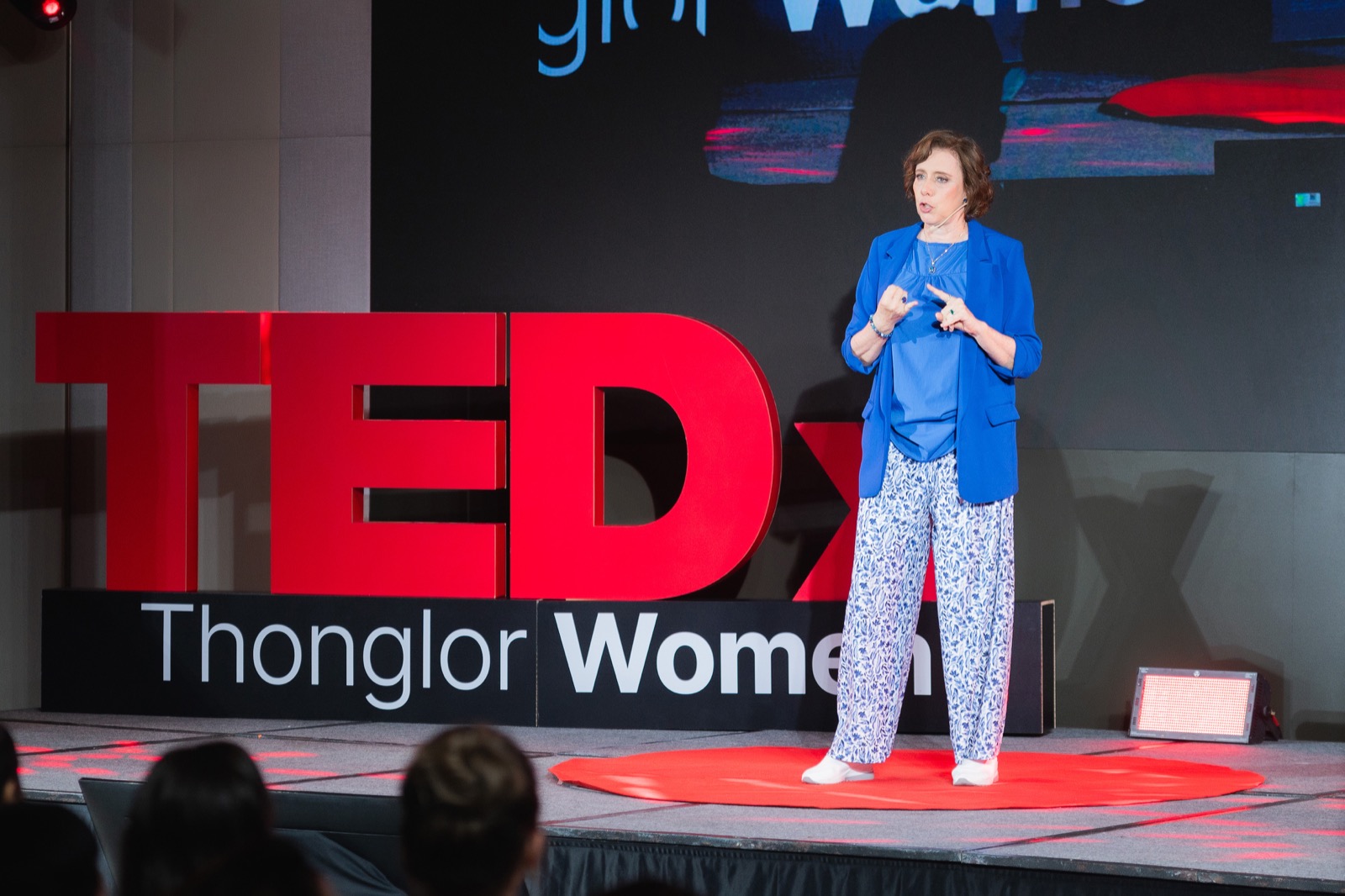
Isabel V Echavarria at TEDx Thonglor Women

About Isabel

Isabel V Echavarria

Leadership Coach · Emotional Wisdom Specialist · EMCC Accredited Supervisor

I am a systemic coach and supervisor who blends emotional wisdom, somatic awareness, and design thinking to help people lead with quiet confidence and clarity.

I built this programme because I kept seeing the same pattern: brilliant, capable people optimising everything in their professional lives — and completely neglecting the one thing that makes everything else possible. Rest.

My approach integrates somatic awareness, cognitive restructuring, and emotional intelligence — because you cannot think your way to better sleep. You have to work with your whole system.

Born in Colombia, based in Chiang Mai, Thailand. I have lived and worked across three continents. I understand what it means to operate in a world that never quite slows down.

EMCC Senior Practitioner & Supervisor TEDx Speaker 2026 ECPP Speaker 2024 Published Author MBSR Teacher 22 Years Experience

TEDx Talk: Defining Balance for the Sandwich Generation · TEDxThonglor Women · April 2026

Book a Clarity Session.

A real conversation — not a sales call. We'll look honestly at what's driving your exhaustion and map a clear path forward.

Whether we work together or not, you will leave with clarity.

Book a Clarity Session →