← Back to Reflections
Inherited beliefs · Boundaries in marriage
The Rule Joe Never Updated
July 28, 2026
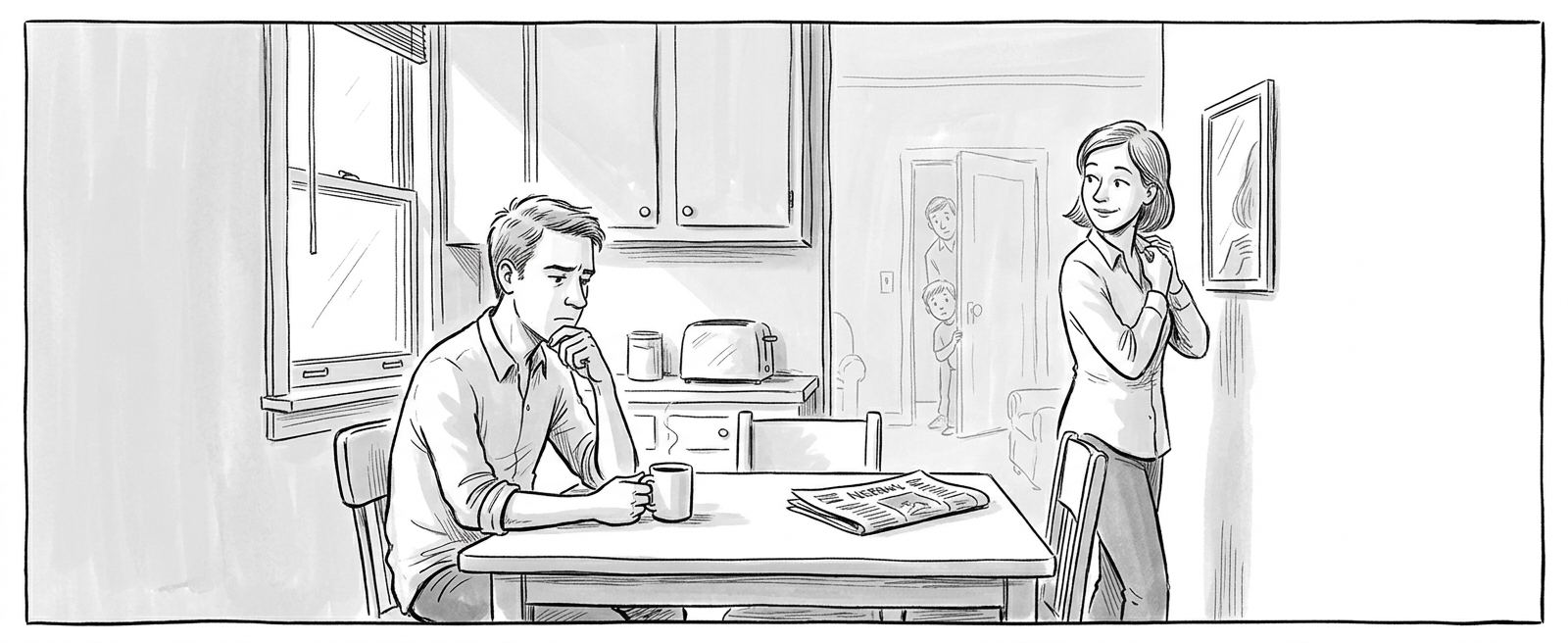
Illustration: AI-generated
Inherited beliefs · Boundaries in marriage
July 28, 2026
Illustration: AI-generated
Joe is newly married, and he's never late getting home, and he doesn't go out drinking with his friends. He just turned down the group's invitation to play football on Sunday morning, and that was hard to do. He feels he needs to be home.
Sunday morning, he sees Susie all dressed up, looking at him puzzled.
Susie: Shouldn't you be getting ready to play football with Brian?
Joe: How did you know?
He asks, surprised.
Susie: You're always talking about how much you love to play, so I talked to the girls and we organised it. You're going to be late.
Joe: I said no. Sunday is for family.
He states proudly.
Susie: This family has plans with Liza and Diana at the mall.
Seeing his disappointment, Susie pauses.
Susie: What's wrong? We don't have to spend every hour together, do we? I thought this was the perfect plan: everyone sees their friends, and then we have dinner together.
Joe couldn't quite put his finger on why it bothered him so much. Later, once Susie had left, he sat with it. He remembered the Sunday mornings of his childhood: his father playing football and then heading to the bar, never home before five in the afternoon. And his mother, left sulking, complaining about being abandoned. He'd decided that a good partner should be present all weekend. He realised he'd turned it into a rule.
Joe grew up watching his mother's frustration every weekend his father wasn't there. As a child, in that house, he drew a conclusion typical of childhood: love shows up as physical presence. Absence is what breaks a family. He carried that conclusion forward as a value, determined to build the perfect relationship by always being present.
Here's the part worth reflecting on: Joe isn't actually choosing his strategy today. He's repeating a rule written decades ago by a child, witness to a relationship that affected him. It's a present-day decision based on expired information: evidence gathered in an early stage of life, applied unquestioned to the adult relationship he's in now.
Nothing in that framework has been updated to fit the person he actually shares his life with today. In truth, this isn't a conflict between family and personal space. It's two people, each defending a fixed strategy for a value they most likely both share: connection.
Everything that happened in the past brought you to where you are now, and that deserves gratitude. But your decisions today are building your future, so it's worth making sure they're based on values and beliefs that hold true now, not simply ones that have never been questioned.
Sometimes the kindest thing you can do with an old rule is thank it, and then let it go.
Untangling which of your boundaries are chosen and which are inherited is exactly the work of a Personal Blueprint: four sessions to find the patterns underneath the patterns.