A story about yourself is one fact plus everything you filled in around it.
At twenty-four, David asked a question in a large meeting and people laughed. That is the fact. It took four seconds.
He is now forty-one. He prepares thoroughly, has good ideas and does not speak in large meetings. If you ask why, he says, “I’m just not a meetings person.”
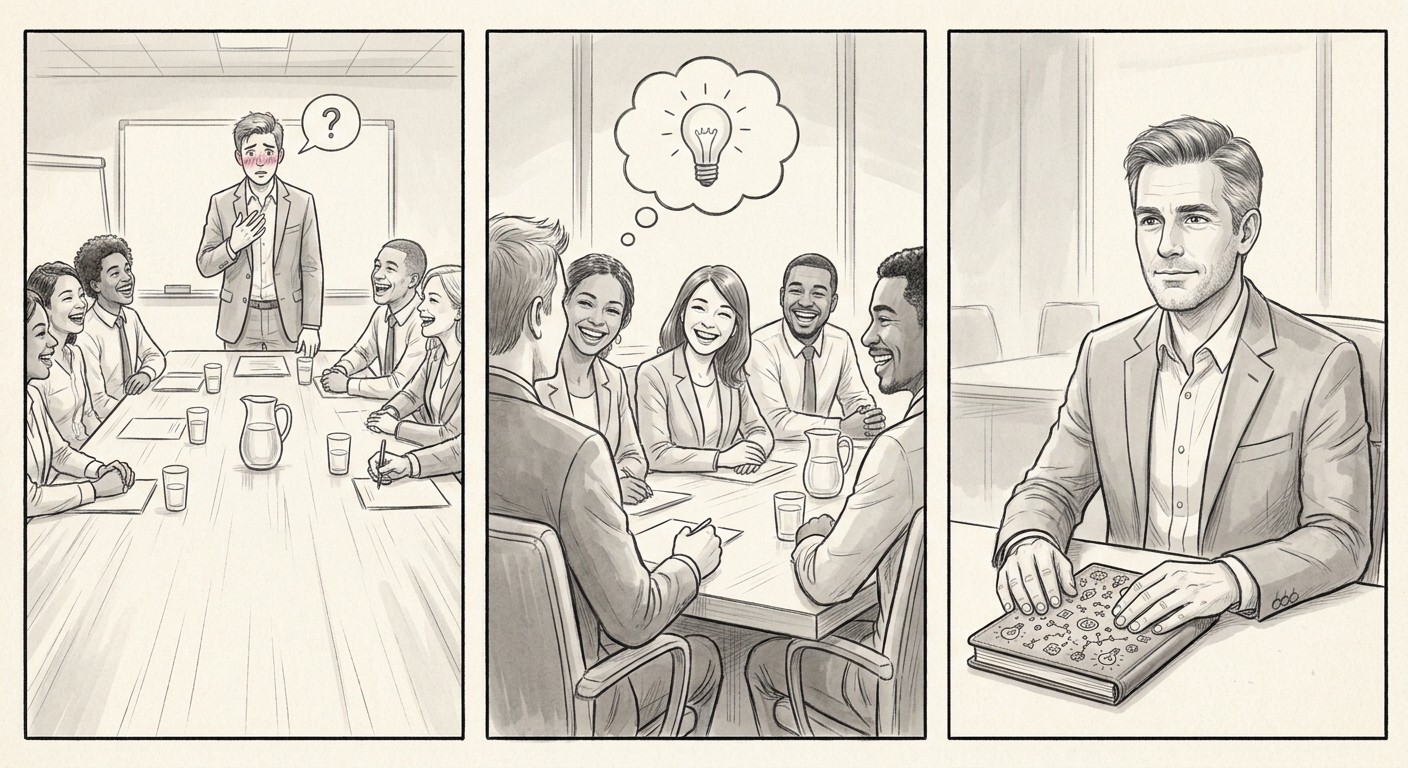
Illustration: AI-generated
Around those four seconds David filled in a motive (they thought I was stupid), a conclusion (I am bad at this) and an ending (it will happen again). Seventeen years later it has stopped looking like a story to him. He experiences it as a description of who he is.
That is how adaptation works. Strong feelings fade after good events and bad ones alike, and with them fades the sense that anything needs to change. We get used to the story we told about the event, more than to the event.
A settled story also works like a thermostat. It sets a comfort band with a floor and a ceiling: how much money feels normal, how much conflict, how much success. Drift below the floor and you correct automatically. Drift above the ceiling and you correct that too, which is why people sometimes undo their own progress. They are defending the band, and neither edge ever gets examined.
When I help someone trace a story, I look for one of four origins.
Borrowed. You adopted a whole approach to work, money or relationships because that is how someone you admired does it. Did you choose it, or copy it? Does it fit your situation, or theirs?
Reactive. “I will be the opposite of my father.” It feels like independence, but the other person is still setting the terms. Moving away from something can scatter you, where moving towards something gives you a direction.
Incident-born. One painful moment quietly became a permanent policy. That is David’s. Would you let a single data point set a lifelong rule anywhere else in your life?
Typecast. You are “the funny one”, “the reliable one”, “the one who copes”, and it has been true for so long that it no longer feels like a choice. A role nobody questions is more like a job nobody assigned you than a personality.
Knowing the origin tells you what to check. Then three questions:
- Whose story is this: mine, borrowed, or built in reaction to someone?
- What detail have I left out?
- Would it survive being told from someone else’s point of view?
For David the missing detail was simple. Several people laughed because the question was the one everyone had been afraid to ask.
A story that is never traced keeps collecting proof. One that has been traced loosens a little each time you notice it.
Which story are you still renting?
Pick one you tell on repeat, name its origin, and decide one thing you will do differently the next time it appears. If you would like company while you trace it, bring it to a clarity session.
The comfort band draws on Gay Hendricks’s “upper limit problem”. This story is fictional.