Almost the same words, with opposite meanings.
You are helping a friend move house. You drop the box with her grandmother’s vase in it, and it breaks.
One voice says: “Oh no. I’m so sorry. Let me find out if it can be repaired.”
Another voice says: “I’m so clumsy. I always do this. I should never have offered to help.” And you spend the rest of the afternoon wishing you could disappear.
The first voice is awareness, what some call healthy guilt: I did something. The second is shame: I am something. Awareness looks at the action and wants to repair it. Shame looks at the whole person and wants to hide.
I think of it as a stone in your shoe. With awareness, your foot hurts, so you stop, take the shoe off, tip the stone out and carry on walking. With shame, your foot hurts and you decide the problem is your foot. You walk faster, hurt it more, and go home to hide.
This matters a great deal in recovery. In one study of newly sober people, researchers asked them to describe the last time they drank and felt bad about it. What people said about their shame predicted nothing. What their bodies showed, slumped shoulders and a narrowed chest, predicted who would relapse in the following months, and how badly. Shame lives below words, and it pushes people back towards the thing that numbs it.
Shame tends to send a person in one of four directions. It can hide or it can attack, and it can turn on yourself or away from yourself. Turned on yourself, it withdraws or attacks you. Turned away, it avoids the feeling altogether or attacks someone else. If the person you love goes silent, or lashes out when a subject comes up, you may be looking at shame and not at indifference.
Four directions of shame
Withdraw“I just want to disappear.”
Attack yourself“I’m so clumsy.”
Away from yourselfAvoid“It wasn’t me, someone else dropped it.”
Attack someone else“You didn’t pack it properly.”
Based on Donald Nathanson’s Compass of Shame.
Families can feed shame or starve it, usually without meaning to. “You always do this” and “what kind of father does that” are shame sentences. “You missed her birthday, and it hurt her” is an awareness sentence. It is every bit as honest, and it leaves the person somewhere to go: the impact of their behaviour is clear, and they can come up with a way to remedy that impact.
Shame grows with secrecy, silence and judgement. It weakens when it is spoken and met with empathy. Being heard without being judged is the thing that lets a person move from “I am bad” to “I did that, and I can repair it.”
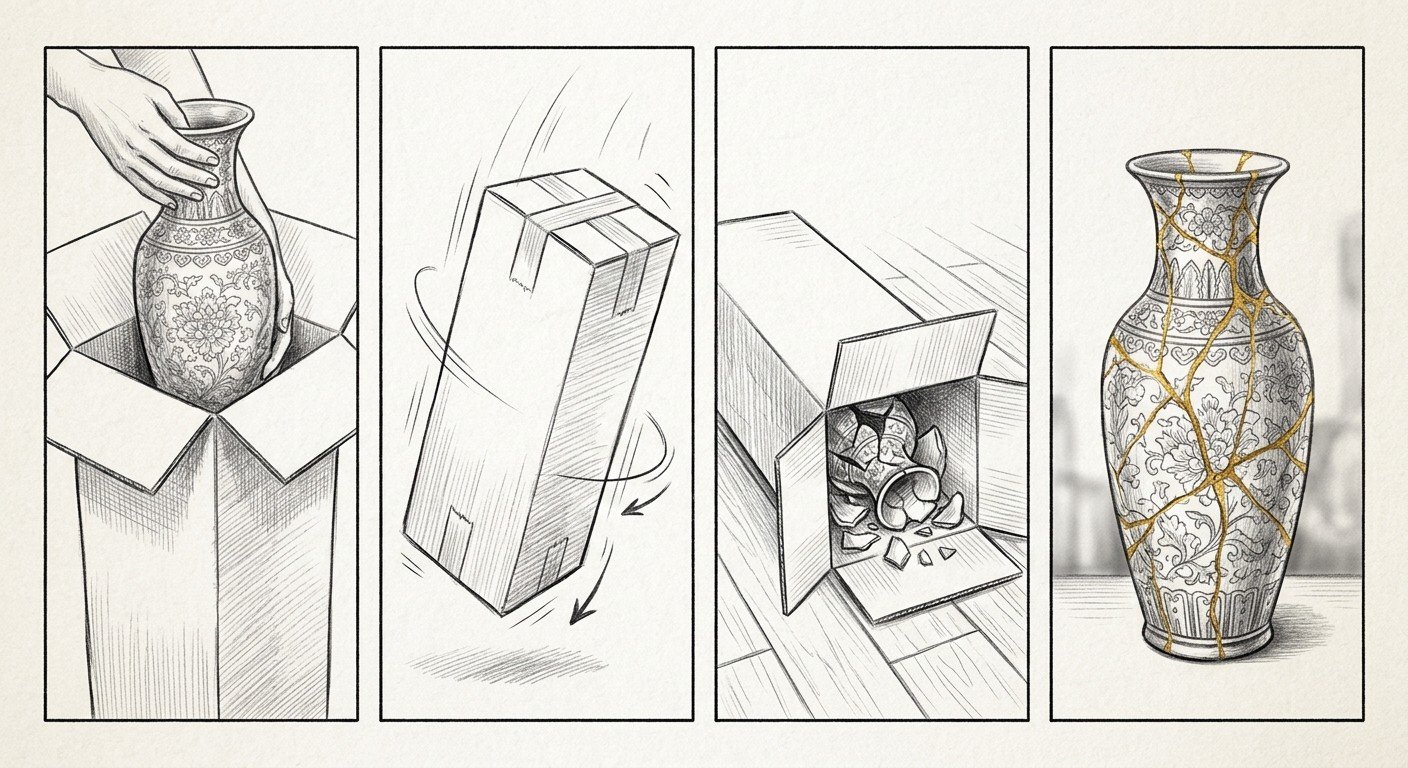
Illustration: AI-generated
Families carry shame too. “What will people say?” and “keep it in the family” are old rules that many of us were handed and never chose.
Which sentence do you reach for?
Next time something goes wrong, notice your first sentence. Is it about what they did, or about who they are? Try saying the first kind out loud, to them and to yourself.
Once a week, try a family circle. Each person shares one thing that happened in their week. Pass an object, a stone perhaps, to show whose turn it is. While someone speaks, nobody comments, advises or corrects: everyone just listens. Talking circles and family support groups work this way, because being heard without being judged is what loosens shame.
If this touches something heavy, talk to someone you trust: a counsellor, a family support group, a good friend. You don’t have to carry it alone either.
Sources: Randles and Tracy (2013), Clinical Psychological Science; Donald Nathanson’s Compass of Shame; Brené Brown on shame and empathy.