“There’s no point trying” is a belief that was learned somewhere real. It can be unlearned.
He was still small when he was taken from his mother. A rope went around one back leg, tied to a stake. He pulled and pulled, and then he stopped.
For years he carried tourists on his back. The rope stayed thin, and he grew strong enough to lift the stake out of the ground without effort. He never tested it again.
When he was old, he was brought to a sanctuary. The trailer door opened onto grass, water and space, and he would not come down, not even for food and treats. Then his mahout went in and tied a rope around one of his legs, and he walked out. It took a long time before he felt at ease without it. The rope had become what felt safe.
The end of this story is real: I heard it at BLES, an elephant sanctuary near Sukhothai, when I visited. The beginning is still the life of many elephants in parts of Asia today.
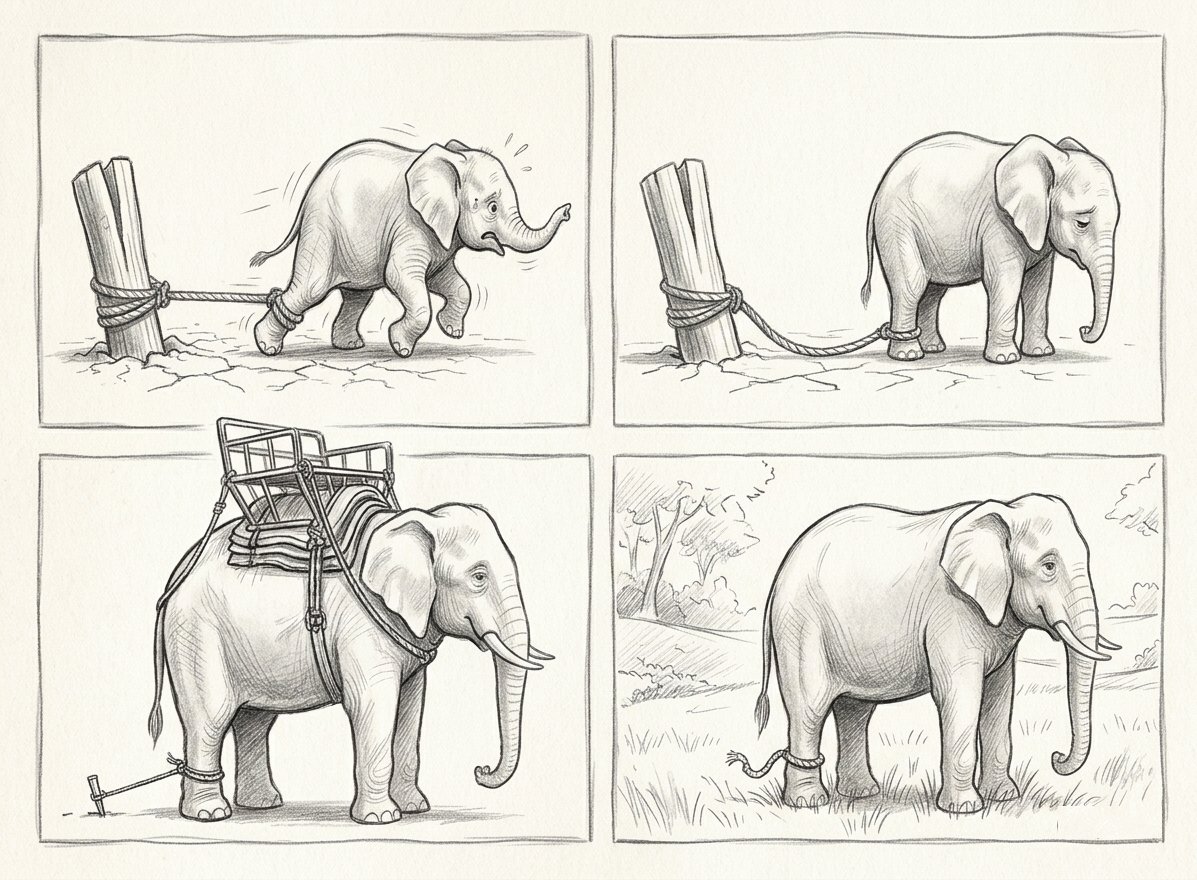
Illustration: AI-generated
Elephants are not the only ones who stop testing the rope. Many people recognise themselves in the elephant calf: tied early, and still holding back long after they could pull free. “I shouldn’t even try.” Families hear it as not caring. It is usually a conclusion drawn in a place where effort truly made no difference: a home, a school, a job, a relationship. There, giving up made sense. The belief then travels to places where it is no longer true.
In the 1960s the psychologists Martin Seligman and Steven Maier named this learned helplessness. Fifty years later they revisited it with what neuroscience had found since, and concluded they had it the wrong way round. Shutting down is the brain’s default under prolonged pain. Nothing has to be learned for that. What has to be learned is the opposite: the sense that what I do makes a difference. Each time a person notices that, the front of the brain quiets the alarm. They called it a hope circuit, and it grows with use.
This is amazingly good news! There is a way out, and the brain simply has to learn it: the rope can be pulled. Thinking differently about the rope does not rebuild the circuit, and neither does being encouraged. Small gestures do: pulling the rope a little at a time, and noticing the stake start to move. An action taken, and a result noticed. The key word is noticed. How often do we dismiss our own achievements? How often do we set ourselves lofty goals that make our days overwhelming?
Yes, we need big goals, but treat them as star goals: you steer by them, you don’t measure your week by them. Then set step goals. My star goal is to run a marathon; this week I walk fifteen minutes a day. Or my star goal is enlightenment; this week I meditate ten minutes a day. The star stays the same. The step is what I check.
At birth, each of us was given a human to look after: ourselves. We have agency, responsibility and accountability for that human. Our human needs looking after every day: fed, rested, spoken to kindly and given small challenges it can meet. Nobody will hand us recovery, and nobody can do it for us. So each day, ask: what will I do today to take care of my human? The work can start small:
Test one rope. Pick one thing you decided long ago “doesn’t work”, and try it once, in a small way. Maybe it is a calm family dinner. Asking everyone to put their phones away can feel like a punishment, so offer something in their place: each of you shares one thing you noticed in the day, just to be noted, not analysed.
Catch the sentence. Listen for always (“it will always be like this”), everything (“I ruin everything”) and me (“it’s because of who I am”). Rewrite it smaller and truer: this time, this one area, and which part was mine. Then set a new objective to take the fear’s place: “I always say the wrong thing” can become “I can take part in the conversation by asking questions; I don’t have to talk about myself.” And if you are with someone who is recovering, watch for your own fear and judgement too.
Notice that it worked. A small win only becomes hope if it is registered. This step is the one most often skipped.
For families, the task is to leave them the rope. Doing everything for someone removes the very evidence they need, however kindly it is meant. Help that leaves them a part to do is worth more than help that does it all. Pushing harder at a person who has frozen tends to deepen the freeze, because freezing is one of the body’s protections and has nothing to do with character.
What you can do is name what you see, plainly: “You called, and it got sorted.”
Which rope have you stopped testing?
The question is for you as much as for them. Many families have their own “there’s no point”. Choose one small thing this week, try it, and notice what happens.
If this touches something heavy, talk to someone you trust: a counsellor, a family support group, a good friend. You don’t have to carry it alone either.
Sources: Seligman and Maier (1967); Abramson, Seligman and Teasdale (1978); Maier and Seligman (2016), “Learned helplessness at fifty”.