In one car factory, any worker could stop the whole line by pulling a rope.
Fremont, California, early 1980s. The General Motors plant there has one of the worst records in the American car industry: people absent every day, drinking on the job, cars leaving the line with faults that everyone saw and nobody reported. The plant closes.
In 1984 it reopens as a joint venture with Toyota, called NUMMI. Toyota rehires most of the same workers. Within a couple of years the plant is producing some of the best-built cars in all of General Motors.
The people were the same, so the difference had to be in the system. One piece of it is my favourite.
In the old plant, the line never stopped. A worker who spotted a fault let it go past, because stopping the line was the one unforgivable thing. The fault travelled downstream and was fixed later, at much greater cost, or not at all.
In the new plant, a cord hung above every station. If you saw a problem, you pulled it. A light came on, a tune played, and a team leader walked over to help. If the problem could not be fixed quickly, the line stopped. Workers were thanked for pulling the cord.
I think of emotions as that cord.
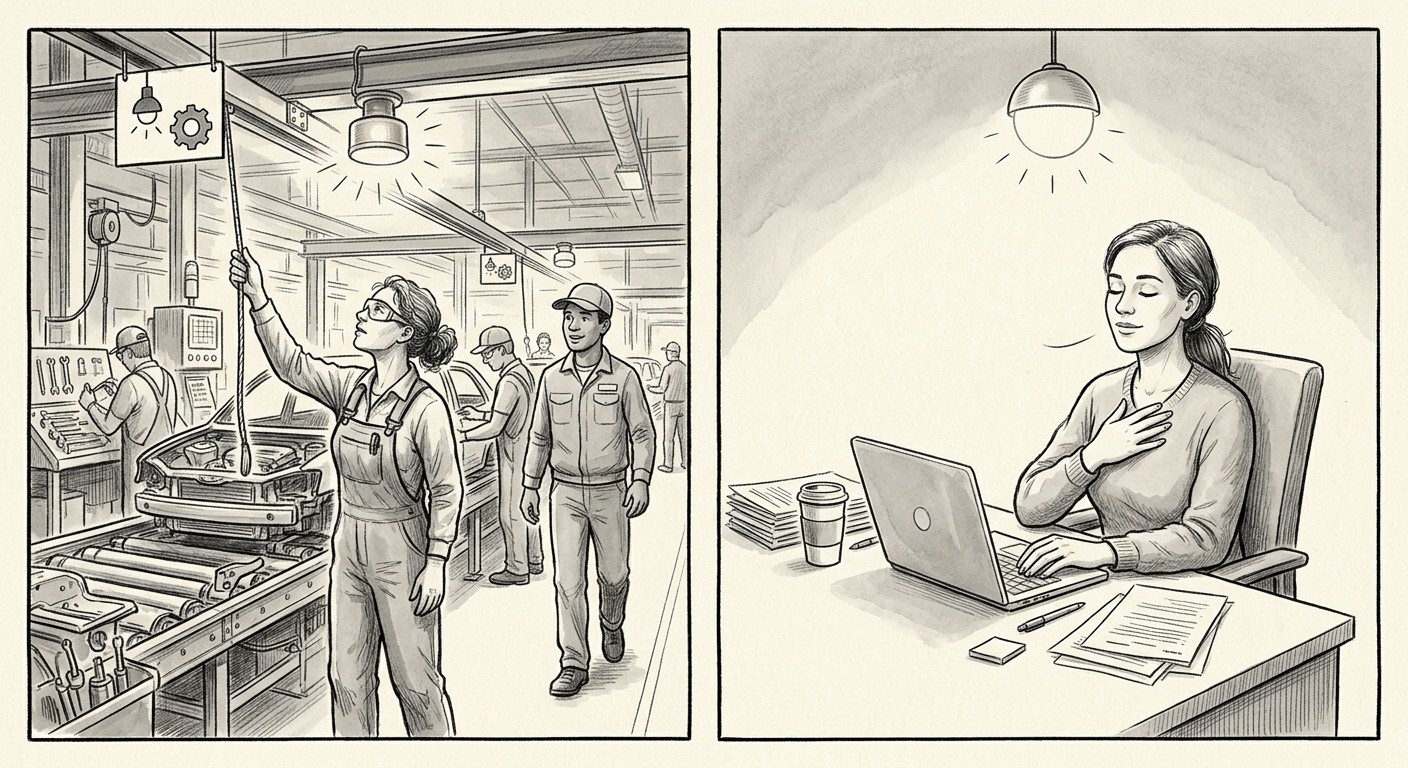
Illustration: AI-generated
Irritation, a tight chest, a sudden wish to leave the room: something has noticed a problem. Most of us run the old factory. We keep the line moving and let the fault travel downstream, where it turns up in the evening as an argument about something else.
The Toyota approach suggests four habits that translate directly.
Stop at the moment of the signal. Pause there and then. Later, the detail has gone. One slow breath is the cord.
Look at three things. The facts: what happened. The feeling: where it sits in the body. The narrative: what I told myself about it. These are often three different stories.
Ask yourself for the suggestion. At NUMMI the improvements came from the people doing the work: small ideas from the line, each one saving a few minutes, every day. You are the person closest to your own line. What small change would make this easier next time?
Keep it respectful. The method only worked because pulling the cord was safe. If you greet every signal with “what’s wrong with me?”, you will stop pulling it. A fault is information about the process, and it says nothing about your worth.
Small improvements, made continuously, are what the Japanese call kaizen. No single one of them is dramatic. Together they changed that factory.
When did you last stop the line?
Once a day this week, pull the cord: what am I feeling, and where do I feel it? Then make one small adjustment. If you would like help reading the signal, bring it to a clarity session.
NUMMI (New United Motor Manufacturing, Inc.) operated in Fremont from 1984 to 2010.