You changed your city, your job, your circle. The reaction came with you.
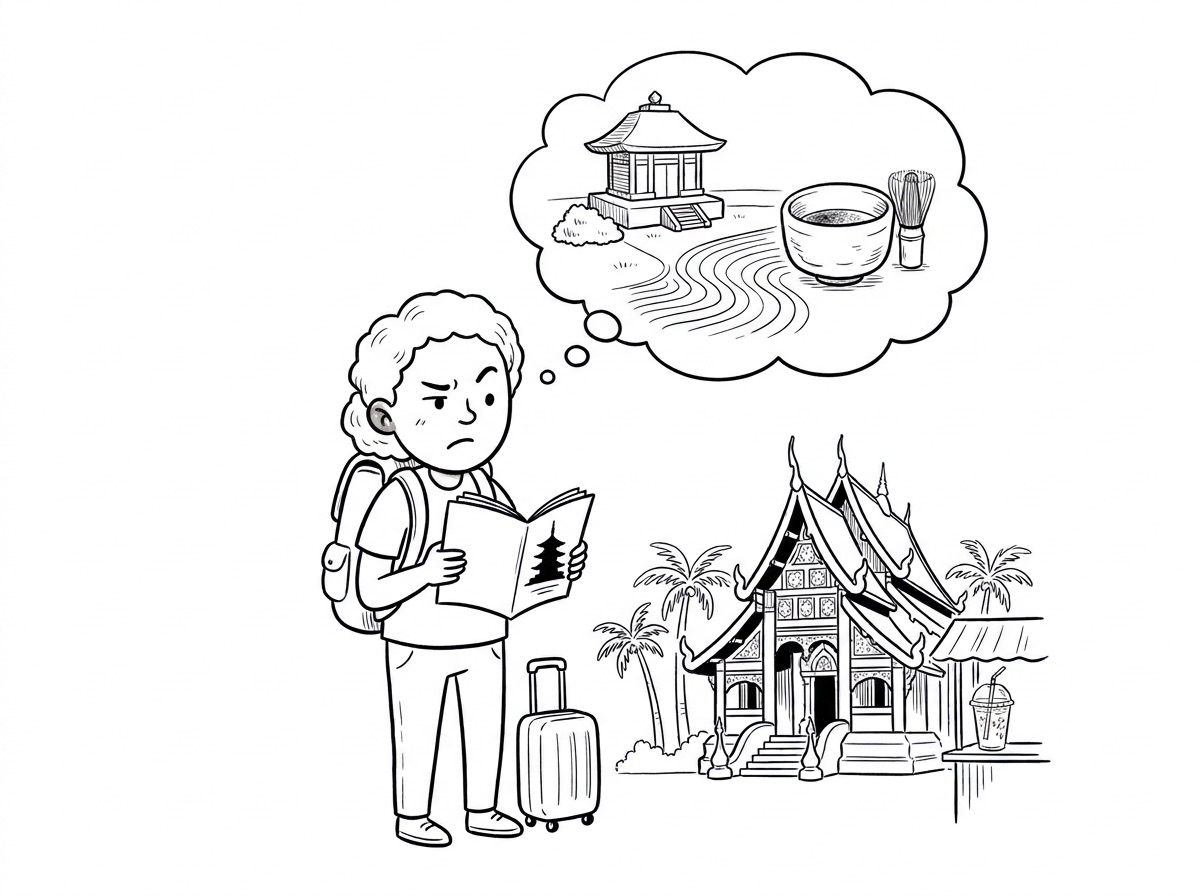
Imagine you plan a trip to Kyoto. You study the temples, the tea ceremony, the raked gravel gardens. Then the plane lands in Chiang Mai. Golden temples where you expected grey stone, Thai tea where you expected matcha, the Ping River where you expected the Kamo.
How long do you walk around with the Kyoto guidebook, annoyed that nothing matches?
Chiang Mai did nothing wrong. It simply isn’t Kyoto. The irritation comes from the gap between what you were sure you would find and what is actually there. Our reactions work the same way. We carry a guidebook of beliefs about how colleagues should respond, how a partner should ask a question and what counts as respect. When the new place, new project or new relationship doesn’t match the book, the reaction fires, and it fires in the same way in every city, project and relationship, because the guidebook is the one thing we kept.
Many people change context and keep using a guidebook written for somewhere else. The setting is different, yet the same irritation, the same defensiveness, the same knot in the stomach turn up within weeks. An ice bath or a breathing exercise will calm the alarm, and those are worth doing. If the knot is still tight, though, the alarm goes off again.
Epictetus put it in one line nearly two thousand years ago: people are disturbed by their interpretations of things more than by the things themselves. You can change the scenery, and the interpretation travels with you.
I use a simple picture of a tree to find the origin of that interpretation, whatever is tightening the knot.
The leaves are what shows. A sharp answer, a tight jaw, a flash of irritation.
The trunk is the thought in that moment, the story you tell yourself.
The roots are the belief underneath, and where it was learned.
Take an ordinary question between partners: “Did you finish the visa application?” The leaves are a defensive, tense reply. The trunk is “they think I can’t manage it”. The roots might be “if I get something wrong, I’m not good enough”, learned years ago from a boss who questioned every piece of work. The partner only asked about a form, and the reaction was answering that boss.
Once the root is visible, Epictetus’ sorting helps. Some things are up to us: our interpretations, what we move towards, what we avoid. Some are not: other people’s opinions, including what they think of us, and the facts of what has already happened. Later writers added a useful middle column, things we can influence without controlling. Most of the tree turns out to sit in the first column, which is good news, because that is where our effort counts.
From there I suggest what I call the Gentle Cycle. Observe the leaf as it happens. Evaluate: trace it to the root and sort it. Decide whether to keep, adjust or drop the belief. Act, in one small way. Then observe again. It is called gentle because a reaction is information about you, and there is no need to treat it as a failure.
Think of one that has turned up in more than one place. Draw the tree: leaves, trunk, roots. If you would like company while you trace it, that is what a clarity session is for.
Ideas from Epictetus (Enchiridion) and William Irvine (A Guide to the Good Life). The couple is imaginary.