A hard idea explained with theory gets a polite nod. The same idea explained with a stone in a shoe stays with you for days.
I once spent ten minutes explaining the difference between shame and awareness, what some call healthy guilt, to a group. I had definitions, a table and a research reference. People listened politely.
Then I asked: “If one foot hurt when you walked, would you notice a stone in your shoe?” I described two people. One stops, takes the shoe off, tips the stone out and walks on. The other decides there is something wrong with their foot, walks faster and goes home to hide.
A man at the back said, “I’ve been blaming my foot for years.”
The table had been accurate, and the stone was something he could use.
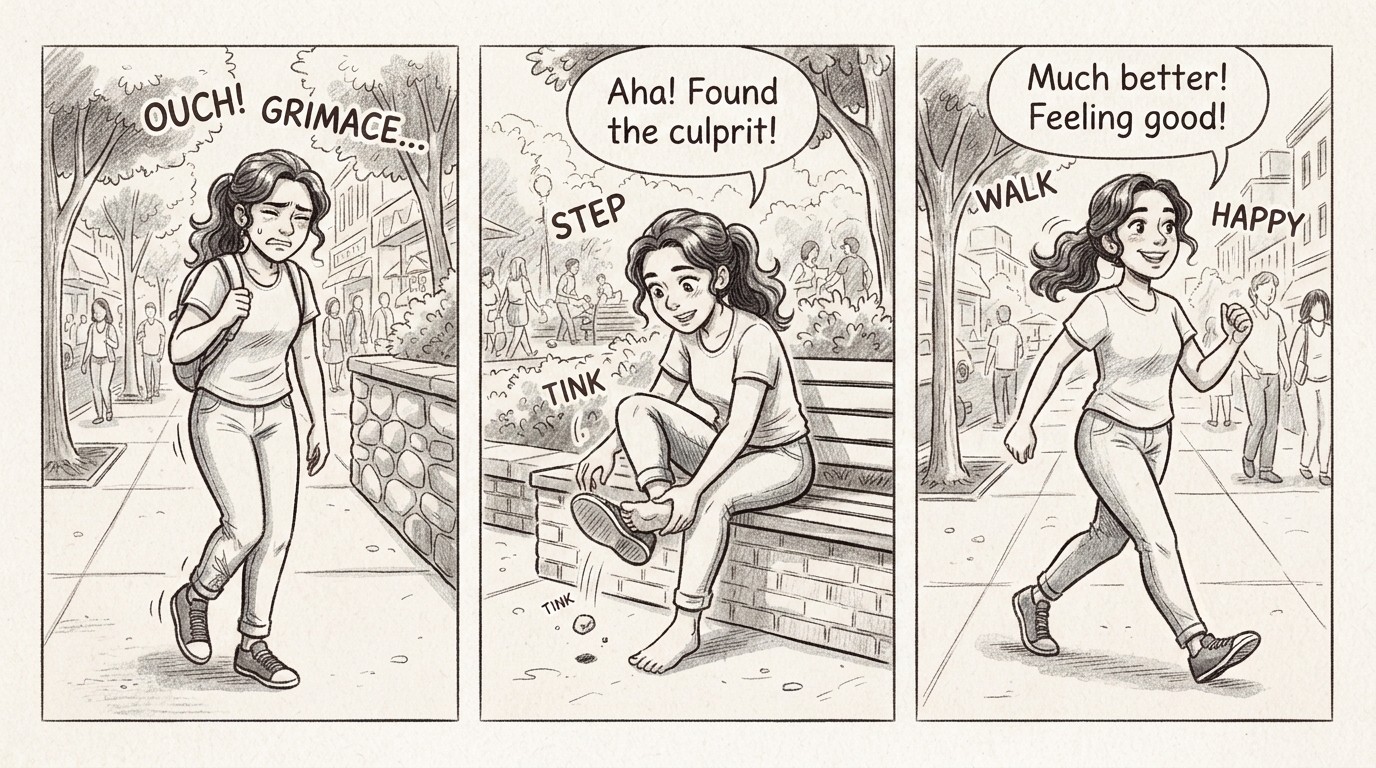
Illustration: AI-generated
I have come to rely on everyday examples for the most difficult conversations, and I think they work for four reasons.
They lower the stakes. Nobody is ashamed of a stone in a shoe or a dropped vase. A person can look at the pattern without first having to look at their worst moment. Once the pattern is clear, they make the connection to their own life themselves, at their own pace. I don’t have to push, and I shouldn’t.
They travel. A concept stays in the room where it was taught. A picture goes home. A lobster that grows sheds its shell and hides, soft and fragile, while the new one hardens: neither here nor there. An elephant tied with a rope when it was small stays put as an adult, simply because a rope is there. Years later, you may feel “I’m between shells” or “that was the pull of the rope again”, and with this knowledge help yourself move forward. Maybe you share this feeling with others, and maybe they know exactly what you are talking about; or maybe not.
They show the options side by side. You are helping a friend move house and you break her grandmother’s vase. How do you react? You can attack her for not packing it properly, attack yourself for being so clumsy, or avoid it: say it wasn’t you, or hide the pieces. What tends to be your default reaction? What would you need to be able to apologise, and even offer to make amends?
They show the whole system. A mobile hangs from the ceiling: touch one piece and all the others move. A family or a team works the same way. When one person changes, everyone around them moves too, and it helps to see that before blaming any single piece.
When I look for an example, I check a few things. It should be ordinary, something from a kitchen, a street or a pair of shoes. It should be a little bit funny or at least light. It should not be about the subject itself: I would not explain shame with a story about shame. And if it is a story rather than science, like the elephant that stops testing its rope, I say so. An example is there to illustrate the idea and is not evidence for it.
Then I stop explaining. The most common mistake is to give the example and then translate it back into theory, in case people missed it. They didn’t. A question does more: where is the stone in your shoe?
You can use this at home as well as in a seminar room. The next time you need to say something difficult to someone you love, try finding the ordinary picture first.
What would your example be?
Think of something you have explained many times without being heard. What everyday object does it resemble? If you would like help finding it, bring it to a clarity session.