“I can’t have dessert” invites an argument. “I don’t eat dessert on weekdays” ends one.
Marco is trying to stop answering work email in the evening. At dinner his phone buzzes. “I can’t check it,” he tells his wife, eyes on the phone. By nine he has checked it.
A month later he tries a different sentence. “I don’t do email after seven.” His wife says he sounded like a different person. The phone was just as loud as before.
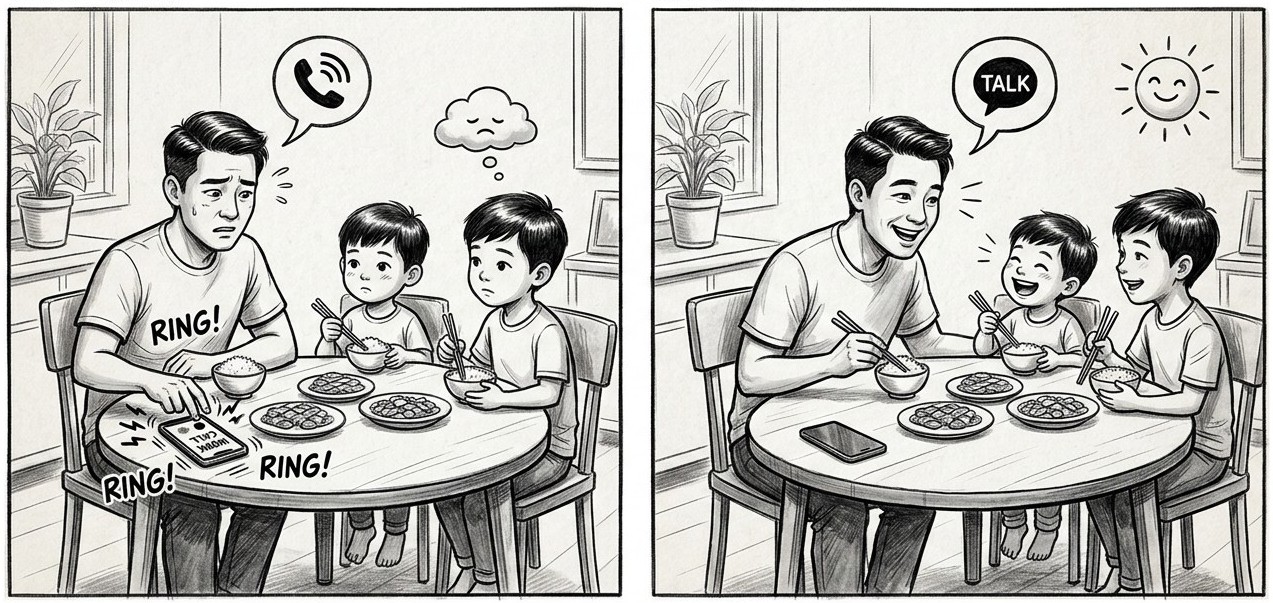
Illustration: AI-generated
Two researchers, Vanessa Patrick and Henrik Hagtvedt, tested this difference. People who framed a refusal as “I don’t” held to their goal more often than people who said “I can’t”. Their studies were about everyday temptations such as snacks and skipped workouts, so I hold the finding lightly. It does match what I see.
“I can’t” sounds like a rule from outside. Someone else has forbidden it, and I am being deprived. It also leaves a door open: other people hear a restriction and helpfully offer a way round it. “Go on, one won’t hurt.” “Who would know?”
“I don’t” is a description of the person speaking. It says: this is how I do things. There is nothing to negotiate, because nobody argues with “I don’t eat meat” or “I don’t drive at night”.
There is a third version that I like even more: “I choose not to.” It is slower to say, and it names what is underneath. Marco’s full sentence turned out to be: “I choose not to do email after seven, because dinner is the one hour I have with my children.” Now the boundary has a value behind it, and the value is the part that holds when he is tired.
This is what I mean when I say a boundary is the edge of a value. “I can’t” protects the rule. “I don’t” and “I choose not to” protect the thing the rule was for.
Three small cautions. “I don’t” only works if it is true, or is becoming true; said as a slogan, it wears out fast. Start with one sentence rather than ten. And expect to be tested once or twice by people who liked the old arrangement. They are responding to a real change.
You can also listen for “can’t” in the other direction, in sentences about things you would like to do. “I can’t ask for help.” “I can’t say no to her.” Is that a fact, or a rule somebody handed you a long time ago?
Which “can’t” would you rewrite?
Pick one “I can’t” from this week and try it both ways: “I don’t ______” and “I choose not to ______, because ______.” If the second half is hard to fill in, a clarity session is a good place to find it.
Source: Patrick and Hagtvedt (2012), Journal of Consumer Research. This story is fictional.